
Screening technology
Trommel screen
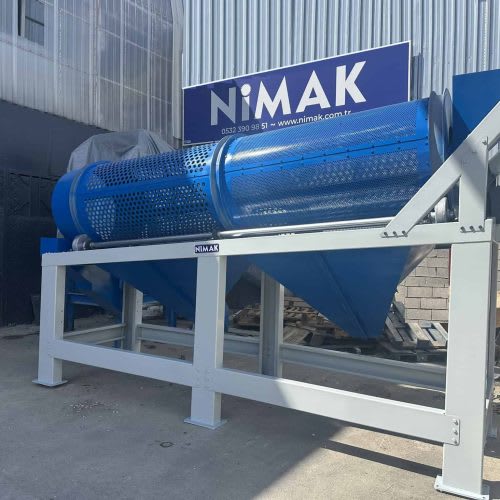
The trommel screen classifies coarse and irregular feed in an inclined, rotating cylindrical drum. Undersize falls through the shell; oversize leaves at the discharge end.
Confirm price, delivery and installation
Operating principle
The drum rotates on an incline about its long axis. Material is lifted, tumbles and passes the shell openings once it is small enough. Oversize travels to the lower end. Replaceable drum surfaces adapt the aperture to the cut. The layout is robust and low-maintenance because few moving parts sit outside the drum.
Where this machine is used
Compost, recycling, excavation soil, sand and gravel, coal, fertiliser, wood chips and agricultural products.
Industries
Advantages
Robust drum for irregular feed
Replaceable drum surfaces
Low maintenance
Straightforward undersize and oversize split
Technical data
Capacity
On request
Drum diameter
On request
Motor power
On request
Drum length
On request
Options
- Different drum surface types
- Spray system
- Enclosure against dust
- Variable drum length and diameter
Industries
- Recycling & compost
- Sand & gravel
- Agriculture
- Coal & fertiliser
Material options
- Compost and biowaste
- Excavation soil and recycle mixes
- Sand, gravel and wood chips
- Fertiliser and agricultural products
Frequently asked sizing questions
How does a trommel screen work?
An inclined screening drum rotates around its longitudinal axis. Feed is lifted, falls and rolls onward. Particles below the selected opening pass through the drum shell, while larger components travel to the discharge end.
Which duties suit a screening drum?
This robust principle is mainly considered for coarse, irregular feed and separation into undersize and oversize. Suitability for compost, recycling mixtures, excavated material, sand, gravel, wood chips or other products depends on moisture, stickiness, contaminants and the separation target.
Trommel screen or vibrating screen?
A trommel screen is typically considered for robust coarse screening and irregular material. A vibrating screen may be more suitable for compact safety screening or defined classification of other bulk solids. Material condition, cut, throughput, space, cleaning and number of fractions determine the choice.
Which process data do we need for sizing?
We need the material, feed and target size, moisture, bulk density, contaminant content, required throughput, operating time and number of fractions. Please also state requirements for drum surface, cleaning or spray system, dust control, inlet and outlet interfaces.
When should another screening principle be considered?
Very fine cuts, strongly adhering material or special requirements for gentle handling and enclosed hygienic processes may call for another screening principle. Widely varying moisture or difficult contaminants also require project-specific assessment.
Related machines
Information for a reliable technical assessment
Complete process data helps us assess the machine, options and scope of supply more precisely.
- Feed material or workpiece and required process result
- Initial condition, target quality and required capacity or cycle time
- Operating conditions such as moisture, temperature, abrasion or hygiene requirements
- Available installation space and mechanical, electrical or process interfaces
- Required scope of supply and technical documentation
Have the machine sized for your process
Tell us the feed material, feed and target particle size, required capacity and operating time. We will assess the technically suitable configuration.