
Screening technology
Shaker screen
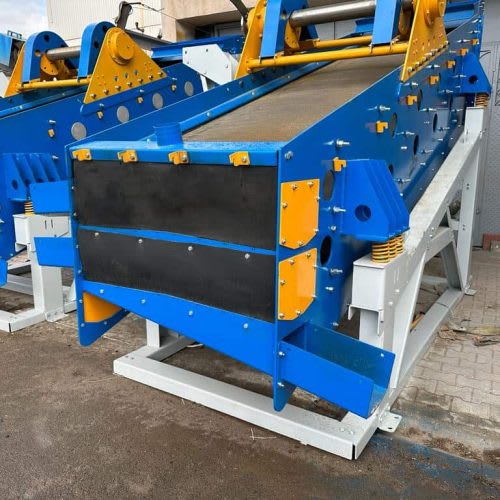
The shaker screen—also called a vibrating shaker in plant language—advances coarse and medium bulk solids on inclined decks. Frequency, amplitude and screen area are sized for the material and throughput target.
Confirm price, delivery and installation
Operating principle
Inclined decks are driven by eccentric or vibration motors in a forward high-frequency, high-amplitude shake. Heavy springs support the screen body. Inclination and amplitude are adjustable so residence time and cut point match the feed. The design is intended for coarse and medium sizes at high tonnage.
Where this machine is used
Mining, quarry, aggregates, sand and gravel, coal, and crushing-screening plants for coarse and medium sizes.
Advantages
Inclined decks sized for the throughput target
Adjustable inclination and amplitude
Eccentric or vibration-motor drive
Heavy spring support for continuous duty
Technical data
Capacity
On request
Screen area
On request
Motor power
On request
Number of decks
On request
Options
- Single or multi-deck
- Wear lining on the feed end
- Spray bars
- Dust cover
Industries
- Mining
- Quarry & aggregates
- Coal
- Crushing-screening plants
Material options
- Aggregates
- Sand and gravel
- Coal
- Crushed run-of-mine rock
Frequently asked sizing questions
What duties suit a shaker screen?
It is assessed for robust coarse and medium classification in quarry, mining and processing plants. Material, feed size, moisture and required products determine decks and drive.
Which data determines deck count and screen area?
Key inputs are size distribution, required fractions, throughput, moisture, bulk density, screening objective and available footprint. Values are calculated for the project.
When is wet screening or a dust cover required?
Spray bars are considered for washable products with suitable water handling. Covers and extraction points are coordinated with the safety and dust-control concept for dusty duties.
Related machines
Information for a reliable technical assessment
Complete process data helps us assess the machine, options and scope of supply more precisely.
- Feed material or workpiece and required process result
- Initial condition, target quality and required capacity or cycle time
- Operating conditions such as moisture, temperature, abrasion or hygiene requirements
- Available installation space and mechanical, electrical or process interfaces
- Required scope of supply and technical documentation
Have the machine sized for your process
Tell us the feed material, feed and target particle size, required capacity and operating time. We will assess the technically suitable configuration.