
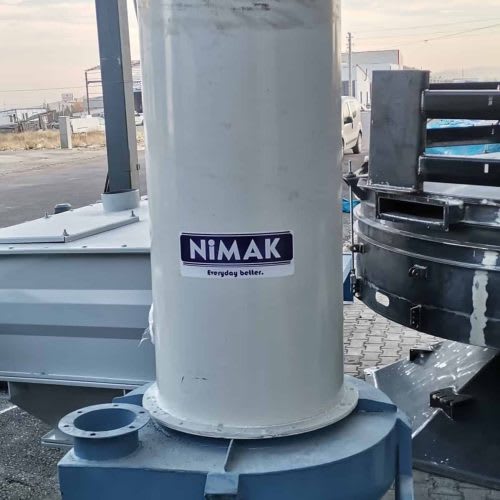
Filtration technology
Cyclone separator
The cyclone separator removes coarse dust and product by centrifugal force. With no moving parts it suits duty as a pre-separator ahead of the jet filter or as a standalone coarse stage on pneumatic lines.
Confirm price, delivery and installation
Operating principle
Dirty gas enters tangentially and forms a vortex. Heavier particles travel to the wall and drop to the underflow; the gas leaves at the top. There are no moving parts. The cyclone often sits ahead of a bag filter to reduce its loading and recover coarse product.
Where this machine is used
Pneumatic conveying and dust collection in wood, cement, food, chemicals and mining.
Advantages
Separation by centrifugal force, no moving parts
Pre-separator ahead of the bag filter
Recovery of coarse fractions
Robust, low-maintenance construction
Technical data
Air volume
On request
Diameter
On request
Pressure drop
On request
Coarse collection efficiency
On request
Options
- Diameter by air volume and loading
- Wear lining
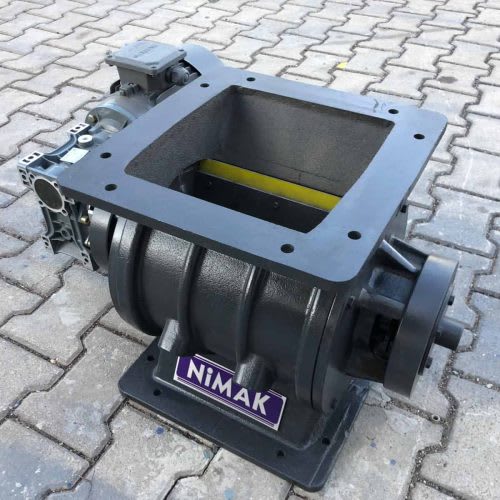
- Rotary-valve discharge
- Combination with jet filter
Industries
- Wood
- Cement
- Food & chemicals
- Mining
Material options
- Wood and cement dust
- Food and chemical dust
- Mineral dust
Frequently asked sizing questions
What data is required to size a cyclone separator?
Required data includes air volume, dust loading, particle-size distribution, bulk and particle density, temperature, moisture, required separation duty and available pressure. Abrasive or sticky materials require additional wear and flow data.
When is a cyclone sufficient and when is a bag filter needed?
A cyclone is primarily suited to coarser particles and pre-separation. Where fine residual dust or a low emission value is required, a downstream filter stage is normally assessed. The decision depends on particle distribution and the permitted clean-gas value.
Is collection efficiency a fixed catalogue value?
No. Expected collection efficiency and pressure drop are calculated for the actual gas and particle duty and, where needed, supported by a trial. Binding values are defined only in the project-specific technical specification.
Related machines
Information for a reliable technical assessment
Complete process data helps us assess the machine, options and scope of supply more precisely.
- Feed material or workpiece and required process result
- Initial condition, target quality and required capacity or cycle time
- Operating conditions such as moisture, temperature, abrasion or hygiene requirements
- Available installation space and mechanical, electrical or process interfaces
- Required scope of supply and technical documentation
Have the machine sized for your process
Tell us the feed material, feed and target particle size, required capacity and operating time. We will assess the technically suitable configuration.