
Feeding & dosing
Rotary valve
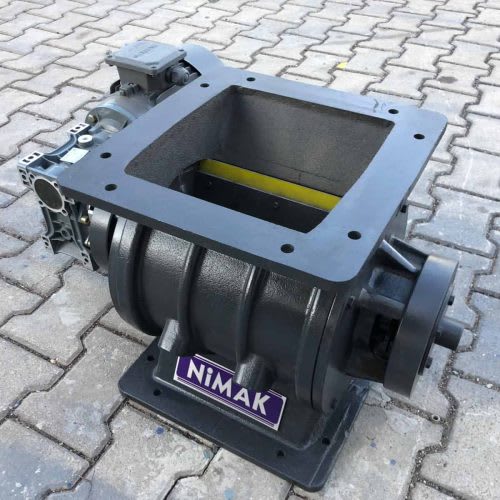
The rotary valve meters powder and granules with a vaned rotor while sealing a pressure difference. Constant speed gives a repeatable feed rate.
Confirm price, delivery and installation
Operating principle
A vaned rotor turns in a precision housing. Each pocket takes material and discharges it on the opposite side. Seal clearances limit false air between silo, filter or pneumatic line. Stainless steel and easy-clean housings suit food and chemicals.
Where this machine is used
Discharge from cyclone and jet filter, silo feeding, airlock on pneumatic conveying and powder dosing – in cement, food, chemicals and minerals.
Advantages
Pressure seal and dosing in one unit
Constant speed, repeatable rate
Stainless steel for food and chemicals
Easy-to-clean housing
Technical data
Throughput
On request
Rotor diameter
On request
Motor power
On request
Differential pressure
On request
Options
- Stainless-steel version
- Wear-resistant rotor and housing materials
- Variable-frequency drive
- Quick-clean housing
Industries
- Cement
- Food
- Chemicals
- Minerals
Material options
- Cement and mineral powders
- Food powders
- Chemical powders
Frequently asked sizing questions
How does a rotary valve work?
A rotor with several pockets turns inside a close-fitting housing. The pockets collect powder or granules at the inlet, carry the material to the outlet and discharge it. Clearances between rotor and housing also limit air exchange between the connected process sections.
Dosing or pressure isolation: what is the difference?
Constant rotor speed supports repeatable feeding, but it does not determine the rate by itself. Bulk density, pocket fill, particle size, flow behaviour, pressure conditions and leakage air must be assessed together. Precise dosing may require additional weighing or control equipment.
Which data do we need for sizing?
We need the material, bulk density, particle size, moisture, temperature, required throughput, operating time and pressures at the inlet and outlet. Please also specify material-of-construction, wear protection, cleaning and existing connection requirements.
When should another discharge or dosing principle be considered?
A standard design may be unsuitable for very sticky, fibrous, highly abrasive or fragile products, or where large foreign objects may occur. Special pressure, hygiene or accuracy requirements also need project-specific review. A size should not be selected without material and pressure data.
Related machines
Information for a reliable technical assessment
Complete process data helps us assess the machine, options and scope of supply more precisely.
- Feed material or workpiece and required process result
- Initial condition, target quality and required capacity or cycle time
- Operating conditions such as moisture, temperature, abrasion or hygiene requirements
- Available installation space and mechanical, electrical or process interfaces
- Required scope of supply and technical documentation
Have the machine sized for your process
Tell us the feed material, feed and target particle size, required capacity and operating time. We will assess the technically suitable configuration.