
Process equipment
Powder mixer
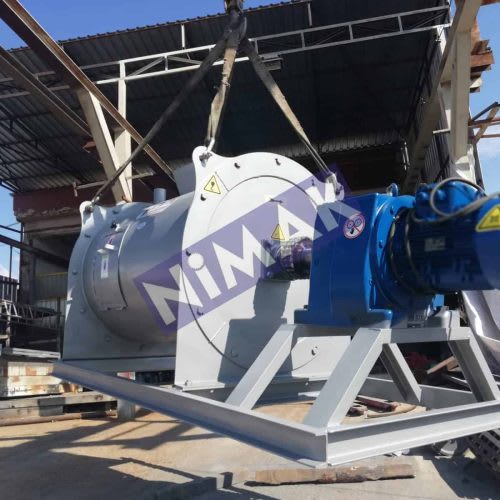
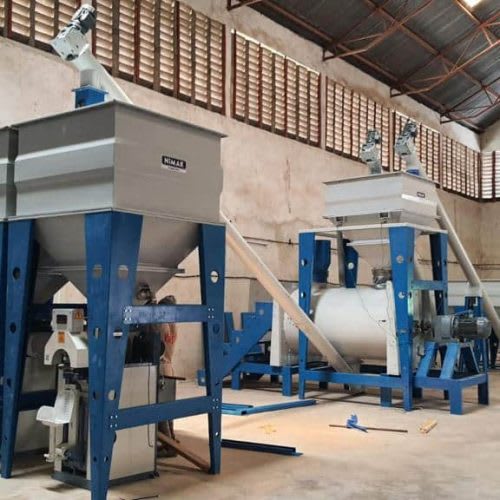
The powder mixer homogenises dry blends with axial and radial motion. Closed housings and a clear discharge keep dust and residues low; stainless steel is optional.
Confirm price, delivery and installation
Operating principle
Paddle, ribbon or conical tools create axial and radial flow. Material is turned until the blend is homogeneous. The housing stays closed. Discharge is arranged so residues stay small. Stainless steel suits food and chemicals.
Where this machine is used
Spices, premixes, flour blends, plasters, mortar, grout, fertiliser, detergent, ceramics and chemicals.
Industries
Advantages
Axial and radial mixing
Paddle, ribbon or conical tools
Closed housing, easy discharge
Stainless option for hygienic processes
Technical data
Working volume
On request
Mixing time
On request
Motor power
On request
Batch rate
On request
Options
- Paddle, ribbon or conical mixer
- Stainless-steel version
- Liquid addition
- Variable-frequency drive
Industries
- Food
- Construction chemicals
- Fertiliser & detergent
- Ceramics & chemicals
Material options
- Spices and flour blends
- Plasters, mortar and grout
- Fertiliser and detergent
Frequently asked sizing questions
Which powder mixer suits the product?
Paddle, ribbon and conical mixers create different product movements. Selection depends on bulk density, particle size, mixing ratio, product sensitivity, discharge and any addition of minor components or liquids.
Which data are required for sizing?
Please state all main and minor components with their proportions, bulk densities and particle sizes, plus batch size and required batches per hour. We also need information on filling, discharge, liquid addition, cleaning, materials of construction and installation dimensions. Mixing time and performance can only be stated after evaluating these data.
When is a special review required?
Large differences in particle size or bulk density can encourage segregation. Sensitive, abrasive, sticky or poor-flowing products and very small additions may require special mixing tools, addition points or trials with original material. Hygiene and product-safety requirements must be defined for the project.
Related machines
Information for a reliable technical assessment
Complete process data helps us assess the machine, options and scope of supply more precisely.
- Feed material or workpiece and required process result
- Initial condition, target quality and required capacity or cycle time
- Operating conditions such as moisture, temperature, abrasion or hygiene requirements
- Available installation space and mechanical, electrical or process interfaces
- Required scope of supply and technical documentation
Have the machine sized for your process
Tell us the feed material, feed and target particle size, required capacity and operating time. We will assess the technically suitable configuration.