
Plant engineering
Calcite coating plant
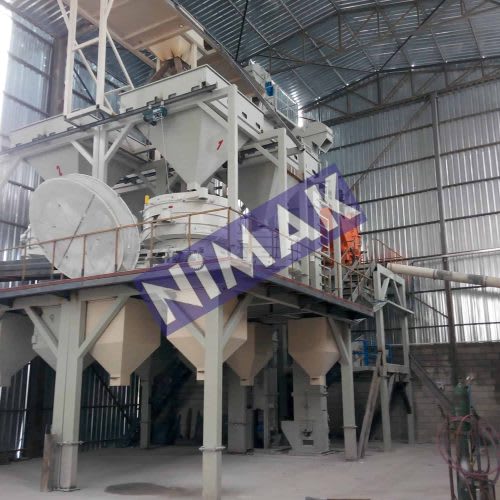
The calcite coating plant coats micronized calcite with stearic acid and similar agents. Dosing, drying, coating, cooling and packing run automated; capacity is set by project.
Confirm price, delivery and installation
Operating principle
Micronized calcite is dosed, dried if needed and wetted in a heated mixer with stearic acid or similar coatings. Cooling and packing follow. The line is automated so temperature, residence time and recipe stay repeatable.
Where this machine is used
Plastics, paint, cable, rubber and construction chemicals – as mineral filler and in masterbatch.
Advantages
Integrated chain from dosing to packing
Heated mixer for stearic-acid coating
Automated recipe and temperature control
Capacity by project
Technical data
Capacity
On request
Mixer volume
On request
Process temperature
On request
Automation level
Automated line
Options
- Drying stage before coating
- Cooling run after the mixer
- Tie-in to packing
- Recipe management
Industries
- Plastics & masterbatch
- Paint & cable
- Rubber
- Construction chemicals
Material options
- Micronized calcite
- Stearic acid and similar coatings
Frequently asked sizing questions
Which raw-material data is needed for a calcite coating plant?
Key data includes size distribution, moisture, bulk density, required coating level, additive, product temperature, throughput and quality test method. These determine dosing, mixer, heating and cooling.
Which units can be included in the scope?
Depending on feed and product, the line can include dosing, drying, heated mixing, cooling, conveying, dust collection and packing. Binding scope is defined in the flow diagram and quotation.
When can product quality and capacity be confirmed?
After assessing raw-material and recipe data and, where required, material trials. Binding values are agreed only in the project-specific technical specification.
Related machines
Information for a reliable technical assessment
Complete process data helps us assess the machine, options and scope of supply more precisely.
- Feed material or workpiece and required process result
- Initial condition, target quality and required capacity or cycle time
- Operating conditions such as moisture, temperature, abrasion or hygiene requirements
- Available installation space and mechanical, electrical or process interfaces
- Required scope of supply and technical documentation
Have the machine sized for your process
Tell us the feed material, feed and target particle size, required capacity and operating time. We will assess the technically suitable configuration.