
Process equipment
Rotary dryer
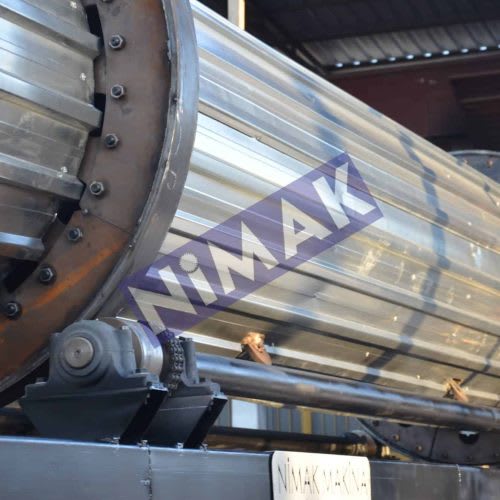
The rotary dryer dries bulk solids in an inclined, rotating drum. Lifters raise the material into the hot-gas stream; temperature and speed stay controllable.
Confirm price, delivery and installation
Operating principle
The insulated drum rotates on an incline. Lifters raise and cascade the material through the hot-gas stream. Temperature and speed control residence time and final moisture. Tyres and rollers support the drum; insulation limits heat loss.
Where this machine is used
Calcite, sand, minerals, fertiliser, sludge and agricultural goods – in mining, chemicals, fertiliser plants and food.
Advantages
Continuous drum drying
Temperature and speed control
Insulated drum, tyres and rollers
Lifters for good gas contact
Technical data
Capacity
On request
Drum diameter
On request
Drum length
On request
Drive power
On request
Options
- Co-current or counter-current
- Lifter set by material
- Burner and gas path by temperature target
- Exhaust dust collection
Industries
- Mining & minerals
- Chemicals
- Fertiliser
- Food
Material options
- Calcite and sand
- Minerals and fertiliser
- Sludge and agricultural goods
Frequently asked sizing questions
What data is required to size a rotary dryer?
Required data includes feed rate, inlet and target moisture, particle-size distribution, bulk density, permitted product temperature, material properties, operating hours, energy source and ambient conditions. A representative sample and existing drying data improve sizing.
Which components can a drying line include?
Depending on the project, the scope can include feeding and dosing, heat generator or exchanger, drum, drive, discharge, exhaust routing, cyclone or filter and controls. Fuel, emission requirements and customer-supplied utilities are defined before quotation.
When can final moisture and energy demand be stated as binding values?
Only after a reliable mass and energy balance based on actual product data; a trial may be required where drying behaviour is unknown. Guaranteed values and measurement conditions are agreed exclusively in the project-specific technical specification.
Related machines
Information for a reliable technical assessment
Complete process data helps us assess the machine, options and scope of supply more precisely.
- Feed material or workpiece and required process result
- Initial condition, target quality and required capacity or cycle time
- Operating conditions such as moisture, temperature, abrasion or hygiene requirements
- Available installation space and mechanical, electrical or process interfaces
- Required scope of supply and technical documentation
Have the machine sized for your process
Tell us the feed material, feed and target particle size, required capacity and operating time. We will assess the technically suitable configuration.