
Conveying technology
Belt conveyor
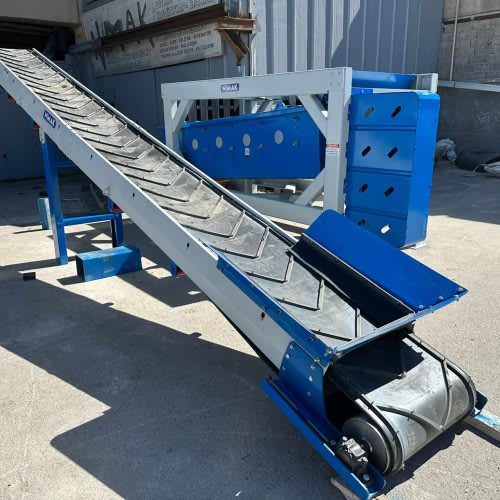
The belt conveyor carries bulk solids on an endless belt between drive and tail pulleys. Width, speed and belt type follow the material and the route profile.
Confirm price, delivery and installation
Operating principle
An endless belt runs on idlers; drive and tail pulleys tension and move the run. The layout is horizontal or inclined. Flat, chevron or sidewall belts are chosen by incline and material. Scrapers, covers and loading hoppers limit spillage and carry-back.
Where this machine is used
Mining, aggregates, coal, grain and fertiliser – in crushing plants, storage and loading.
Industries
Advantages
Horizontal and inclined runs
Belt type by incline and material
Scrapers and covers against spillage
Loading hoppers for clean feeding
Technical data
Capacity
On request
Belt width
On request
Conveying length
On request
Motor power
On request
Options
- Flat, chevron or sidewall belt
- Scraper package
- Weather and dust cover
- Loading hoppers and transfer chutes
Industries
- Mining & quarry
- Aggregates
- Grain & fertiliser
- Coal
Material options
- Aggregates
- Coal
- Grain
- Fertiliser
Frequently asked sizing questions
Which data determines a belt conveyor?
Material, bulk density, particle size, throughput, route length, lift, incline, loading and discharge points, and daily operating time determine width, speed, belt and drive.
Which belt type suits the route?
Flat, chevron or sidewall belts are selected by incline, particle size, rollback tendency, temperature and product compatibility. Final selection belongs in the project specification.
How are dust and material loss limited?
Loading hoppers, transfer chutes, covers, side guides and scrapers are adapted to loading and discharge. Required extraction connections are coordinated with the dust-control design.
Related machines
Information for a reliable technical assessment
Complete process data helps us assess the machine, options and scope of supply more precisely.
- Feed material or workpiece and required process result
- Initial condition, target quality and required capacity or cycle time
- Operating conditions such as moisture, temperature, abrasion or hygiene requirements
- Available installation space and mechanical, electrical or process interfaces
- Required scope of supply and technical documentation
Have the machine sized for your process
Tell us the feed material, feed and target particle size, required capacity and operating time. We will assess the technically suitable configuration.