
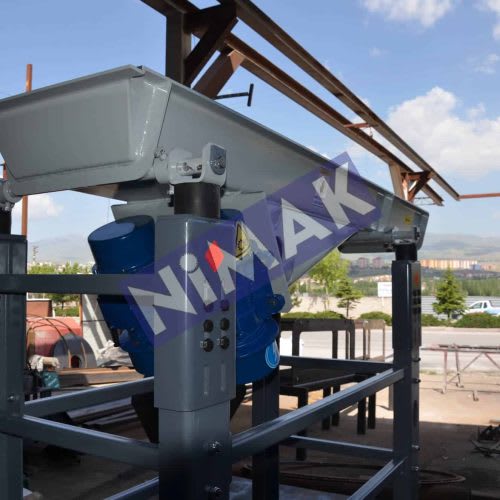
Feeding & dosing
Vibrating feeder
The vibrating feeder moves bulk solids in a trough with a motor or electromagnetic drive. Adjustable amplitude meters the feed onto downstream machines with few moving parts.
Confirm price, delivery and installation
Operating principle
A trough is set into longitudinal vibration. Material advances in small throws. Motor unbalance or electromagnetic drives set the amplitude. Few bearings and no belts keep maintenance low. Typical duty is as buffer and feeder ahead of crusher, screen, conveyor or packer, and at silo discharge.
Where this machine is used
Feed to crusher, screen and conveyor, silo discharge, dosing and packing – in mining, aggregates, food, chemicals and fertiliser.
Advantages
Adjustable amplitude
Few moving parts
Buffer and dosing in one trough
Motor or electromagnetic drive
Technical data
Capacity
On request
Trough width
On request
Trough length
On request
Drive power
On request
Options
- Motor or electromagnetic drive
- Trough wear lining
- Enclosed trough against dust
- Frequency control
Industries
- Mining & aggregates
- Food
- Chemicals
- Fertiliser
Material options
- Crushed rock and sand
- Food and chemical powders
- Fertiliser granules
Frequently asked sizing questions
What data is required for a vibrating feeder?
Required data includes material, particle-size range, bulk density, moisture, temperature, required mass flow, feeding method, buffering need, installation length and operating hours. Abrasiveness and dust behaviour also determine trough material, lining and enclosure.
Can a vibrating feeder dose precisely?
It can create an adjustable, even material flow, but achievable dosing accuracy depends on flow behaviour, fill level, drive, control and calibration. Binding tolerances are defined for the actual product in the project specification.
When is a motor drive or electromagnetic drive selected?
Selection depends on throughput, control range, trough mass, intermittent duty and process interface. Electromagnetic drives often suit smaller finely controlled duties, while motor unbalance drives are commonly assessed for robust continuous service.
Related machines
Information for a reliable technical assessment
Complete process data helps us assess the machine, options and scope of supply more precisely.
- Feed material or workpiece and required process result
- Initial condition, target quality and required capacity or cycle time
- Operating conditions such as moisture, temperature, abrasion or hygiene requirements
- Available installation space and mechanical, electrical or process interfaces
- Required scope of supply and technical documentation
Have the machine sized for your process
Tell us the feed material, feed and target particle size, required capacity and operating time. We will assess the technically suitable configuration.